Stability AI is trying to rebuild itself around a narrower, more defensible business: AI tools for music creation and editing. In late August, the company said it raised $76 million from investors including Sony Music Group, Universal Music Group and Warner Music Group, and said those labels licensed catalogs for training as part of the deal (company release). On Oct. 2, TechCrunch reported that Sean Parker, now an investor and board member, said the company’s aim is to become the go-to AI toolmaker for music professionals (TechCrunch).
The reported shift matters because it is both strategic and practical. Stability was once identified mainly with image generation, but TechCrunch said Parker joined an $80 million rescue two years ago after overspending and internal turmoil helped push founder Emad Mostaque out. The new framing suggests the company is trying to avoid the broad, unresolved questions that surround general-purpose generative media and instead sell a more specific product category: licensed music models that plug into professional workflows.
What Stability says it has built
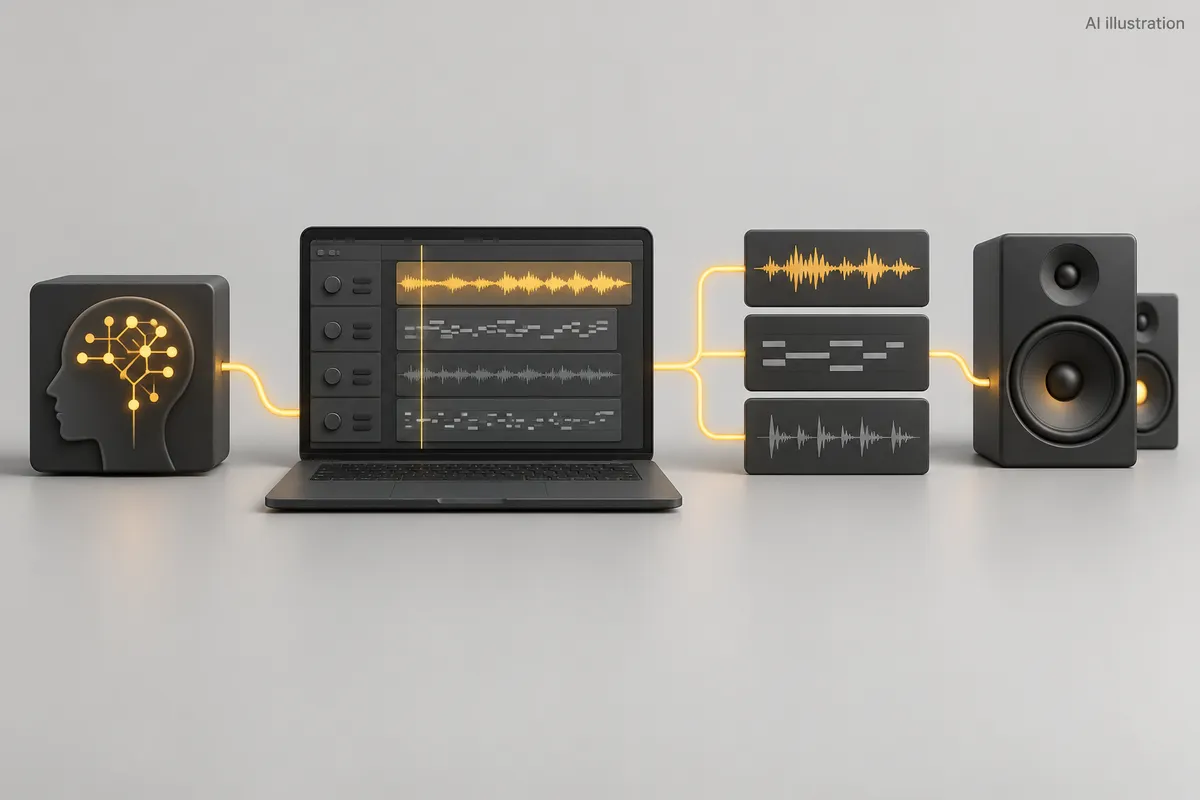
Stability says the centerpiece is Stable Audio 3.0, a family of open-weight music models trained on fully licensed data. The company also says artists can use the system through a digital audio workstation plugin or on StableAudio.com. TechCrunch reported that Stability has already released three audio models and AI music-editing software, with the system able to generate complete instrumental tracks or short snippets from text prompts.
The notable product detail is Parker’s description of an upcoming update that would let users hum a melody or beatbox a drum pattern to guide generation. That is more than a cosmetic feature. It moves the interaction model away from text-only prompting and toward performance-conditioned creation, which is closer to how musicians actually sketch ideas. In a studio context, a user may be able to steer the model with a rough vocal line or rhythm rather than trying to describe the sound in words.
Why the licensed-data pitch is central
For Stability, the licensing claim is doing a lot of work. It is not just a legal talking point; it is the basis for a commercial story that labels, investors and professional users can tolerate. If a music model is trained on catalogs that have been explicitly licensed, the company can argue that it is building with rights holders rather than against them. That is a meaningful distinction in a sector where provenance, clearance and trust matter as much as output quality.
The distribution choice matters too. A DAW plugin places the model inside the place where producers already edit, arrange and export songs. That can make the difference between a novelty demo and a tool that becomes part of daily production. If the software works as advertised, a producer could use it for quick idea generation, scratch arrangements or iterative edits without leaving familiar tools.
But the sources still leave important gaps. Neither report independently verifies the exact licensing terms, the scope of the catalog access or whether the resulting outputs are cleared for every commercial use case. The company’s claim of “fully licensed” training data is a business assertion, not proof that every downstream user gets the same legal protection. The sources also do not establish how Stable Audio compares with rivals on quality, speed or adoption.
What this means for AI builders and buyers
For AI builders, Stability’s move is a reminder that generative media is becoming less about raw model novelty and more about workflow, rights and distribution. A music model can be technically impressive and still fail if it cannot fit into professional production or if its training data creates legal friction. Stability appears to be betting that music AI becomes more durable when it is sold as a licensed, studio-adjacent tool rather than a general-purpose generator.
For music professionals and buyers making procurement decisions, the practical question is no longer just whether the model can generate a convincing clip. It is whether the vendor can explain the training set, the usage terms and the workflow boundary between the model, the DAW and any human review before release. That is the real decision line in this story: the product only becomes useful if its rights story and integration story are both credible.
Source: techcrunch.com, stability.ai
Track whether Stability’s next audio update adds more session-ready controls, because that will show whether licensed music AI is becoming a usable production tool or just a cleaner story.