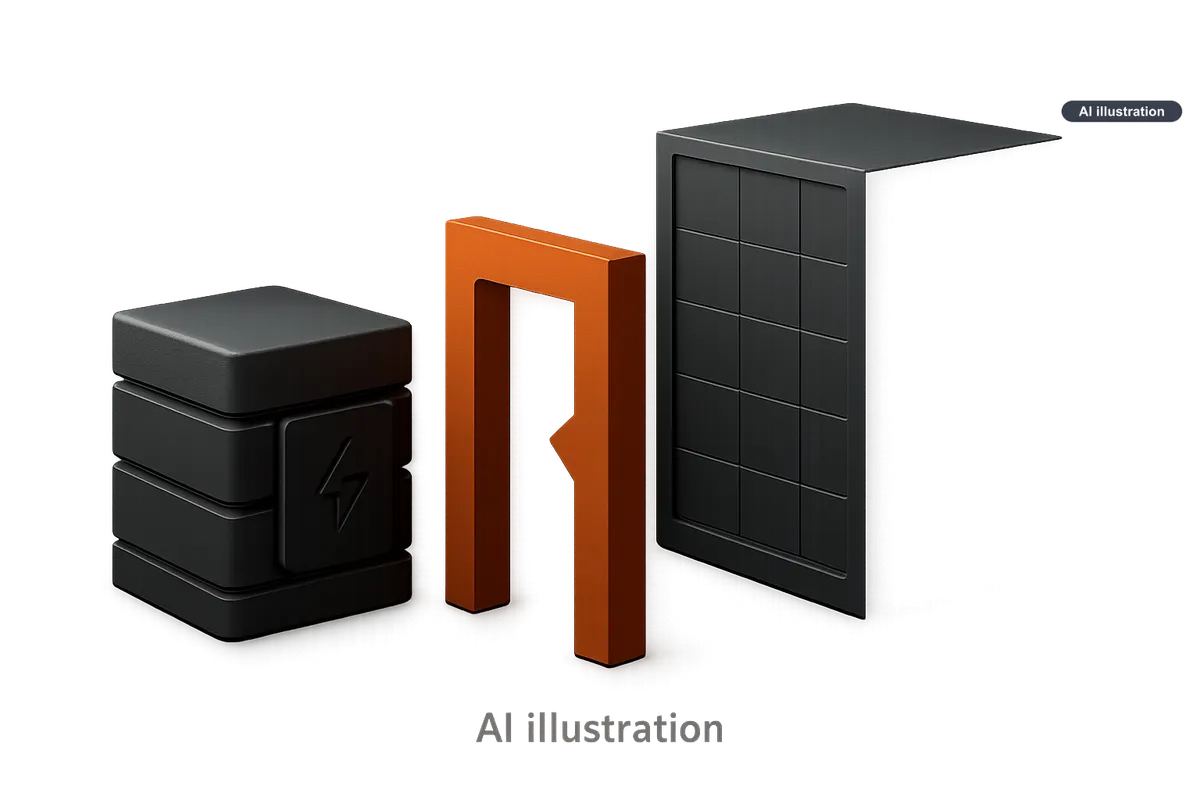
NVIDIA said on Sept. 21 that it has launched DSX Ready, a qualification program for partner power and cooling products that meet its DSX AI factory reference design requirements. The launch starts with battery energy storage systems, or BESS, and cooling distribution units, or CDUs, according to NVIDIA’s announcement.
The practical change is not a new model or a new benchmark. It is a procurement filter for the infrastructure that AI factories depend on. NVIDIA says DSX Ready gives builders a category-specific qualification to look for and gives vendors a defined way to show that a product fits the requirements for its category. In the launch announcement, NVIDIA said BESS partners must run qualification tests and submit supporting data for review, while CDU vendors use a self-qualification suite. NVIDIA also listed initial qualified BESS suppliers as Hitachi Energy, LG Energy Solution and Tesla, and initial CDU suppliers as LG Electronics, LiquidStack and Vertiv.
Why NVIDIA is drawing the line here
AI data centers are increasingly constrained by power delivery and cooling rather than by rack space alone. NVIDIA’s DSX framing treats compute, networking, power, cooling, facilities and software as one system, which reflects a basic operational reality: improving one layer can shift the bottleneck to another. If a site can accept the latest accelerators but cannot bring enough power online, or cannot move heat away fast enough, the project still stalls.
That is why a qualification program matters. A DSX Ready label can shorten the first pass at vendor selection for builders who need to reduce integration risk before they commit capital. For suppliers, the benefit is access to a named NVIDIA-aligned requirement set rather than an undefined “works with AI infrastructure” claim. For operators planning new capacity, the label may help compare equipment categories more quickly, especially when delivery timelines are tight and grid or water constraints are already shaping the design.
A separate report from East Asia Brief said LG Energy Solution described its approved battery configuration as a 2.5-megawatt, 5.1-megawatt-hour block and framed the qualification as relevant to backup power for AI campuses. Because that report is secondary and relies on company statements, it should be read as context rather than independent proof of deployment scale. Even so, it points to the kind of equipment NVIDIA is trying to standardize: modular blocks that can be inserted into a larger site design rather than one-off custom systems.
What the qualification does not do
The most important limiter is in NVIDIA’s own language. The company says qualification does not replace site-level engineering and does not imply site-level stability. That boundary matters because an item can match a reference design and still be wrong for a specific facility. Utility interconnects, redundancy targets, local fire and electrical codes, physical layout, operating temperature, and the planned workload profile can all change the right answer.
For that reason, DSX Ready is best understood as a narrowing step, not a final verdict. It can tell a builder that a product is eligible for consideration under NVIDIA’s requirements, but it cannot tell the builder whether the full project will run safely, economically or reliably on that site. That is especially true for BESS, where thermal, electrical and safety integration affect not just performance but permitting and operating risk.
There is also no evidence in NVIDIA’s announcement that DSX Ready proves field performance. The blog post does not publish independent benchmarks, delivery volumes, contract values, uptime figures or customer adoption data. It establishes a qualification framework and the initial product categories, but not the long-term market impact. That makes the news real, but still bounded: NVIDIA is creating a buying signal, not claiming to have solved the entire AI-factory infrastructure problem.
The broader implication is commercial rather than theatrical. As AI campuses grow, the infrastructure market is moving closer to productized, pre-screened building blocks. That should help some buyers move faster, but it also raises the importance of reading the label correctly. Qualified gear may be a good starting point; it is not a substitute for the facility model.
Watch whether NVIDIA expands DSX Ready beyond BESS and CDUs, because that will show whether the company is turning the program into a broad procurement standard or keeping it as a narrow qualification gate.