New research argues that small fine-tuning datasets can make language models forget more than developers realize. The proposed solution borrows information from the original model—but the business question is whether that extra constraint protects the behavior that matters outside the training set.
A company does not usually adapt a language model because it has millions of examples of its own work. It adapts one because it has a few thousand examples, or perhaps a few hundred, and wants the model to speak its vocabulary, follow its procedures and improve on a narrow task. The attraction of supervised fine-tuning is obvious: change the model's behavior by showing it the desired responses. The less obvious risk is that the new examples become the loudest signal in training, quietly narrowing what the model knows how to do elsewhere.
That is the problem a new preprint, “Ambient LLMs: Data-Efficient Supervised Fine-tuning via Temperature Matching,” tries to address. Researchers Giannis Daras, Marios Papachristou, Adam Klivans, Antonio Torralba and Constantinos Daskalakis propose maintaining a frozen copy of the pretrained model as a noisy teacher while adapting a second model on a much smaller labeled dataset. Their method asks the adapted model to remain close to the pretrained model's conditional output distribution when that distribution is smoothed by temperature. The authors report improvements over standard supervised fine-tuning across domain adaptation, instruction tuning and reasoning, with up to 21% average relative improvement in their evaluations.
The result is interesting, but the phrase “21% improvement” needs care. It is a reported relative change in the study's evaluated metrics, not evidence that any fine-tuned chatbot becomes 21% more accurate, cheaper or safer in production. Nor does it show that the original model's beliefs are always right. The substantive question is more demanding: can developers make meaningful narrow changes without losing useful general behavior that their small dataset never tested?
Why the small dataset can be a trap
Supervised fine-tuning repeatedly rewards the model for assigning more probability to examples selected by the developer. When those examples are few or highly repetitive, the model can learn patterns that fit the examples rather than the broader task. In neural networks this is related to overfitting; in language-model adaptation it can also produce catastrophic forgetting, where improvements in one setting are accompanied by losses in other capabilities.
Consider a support assistant adapted to an organization's ticket history. The data may contain excellent examples of resetting accounts and explaining common billing issues, yet almost no examples of regulatory exceptions, rare outage modes or unfamiliar customer requests. A model that becomes extremely confident in the common workflows can be more consistent on a held-out slice of the same ticket distribution while performing worse when a rare case arrives. A conventional test set may not reveal the trade-off if it shares the same selection bias.
Developers have long tried to manage adaptation costs with parameter-efficient techniques such as low-rank adaptation (LoRA), which changes a smaller set of parameters rather than retraining an entire model. That can lower compute and storage costs, but it does not by itself prove that altered behavior remains faithful outside the examples. The Ambient SFT proposal addresses a different layer of the problem: what should constrain the learner's output distribution while it is absorbing a narrow set of demonstrations?
What the frozen teacher is actually doing
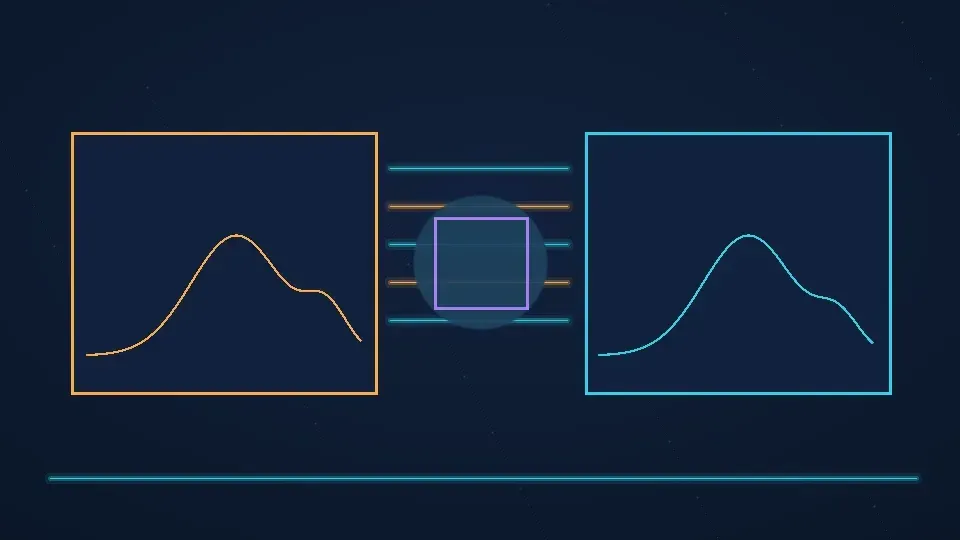
The method retains a frozen pretrained model and compares its conditional predictions with those of the fine-tuned learner. Rather than requiring the learner to copy every sharp preference of the original model, the researchers smooth the probability distributions with a temperature parameter. That creates a mechanism for preserving coarse relationships among possible next tokens while still allowing training examples to push the adapted model toward the target behavior.
There is a useful intuition here. A traditional fine-tuning example says, “In this situation, produce this answer.” The additional teacher constraint says, “While learning this answer, do not arbitrarily distort the broader map of plausible language that the original model had learned.” The latter instruction is soft and mathematical rather than a natural-language prompt; it changes the learning objective itself.
Temperature provides a dial between preserving the original behavior and fitting the new examples. The paper describes the temperature-one setting as connecting to knowledge distillation, while in the high-temperature limit the method approaches ordinary supervised fine-tuning. These limiting cases matter because they make the proposal less like a mysterious new training trick and more like a controlled compromise between a prior model and a specialized dataset.
But that compromise is not necessarily optimal for every organization. If the original model systematically misunderstands a specialized domain, constraining the learner too strongly could preserve the wrong behavior. If a domain has high stakes, retaining fluent general knowledge may be less important than eliminating dangerous outputs. The frozen model is useful background information, not a source of truth. Measuring how much to trust it is part of the method's value—and its deployment risk.
Data scarcity is not the same as low cost
One temptation is to treat the method as a shortcut for organizations that lack sufficient labeled data. The preprint offers evidence that better use of existing pretrained information can improve adaptation, but it does not make data collection free. The teacher still needs to be evaluated, its predictions computed or cached, and the learner trained and tested across multiple conditions. Depending on the model architecture and implementation, those steps can add engineering and inference expense to the training process.
That trade-off could still be attractive. Collecting specialized examples from lawyers, engineers or clinicians may be expensive, slow or limited by privacy obligations. Spending additional computation to make each example more effective could be rational if the resulting model performs better on actual tasks. The right comparison therefore includes the entire pipeline: preparing examples, protecting confidential data, producing teacher targets, tuning the model, testing rare cases and maintaining it as requirements change.
It also changes the way a buyer should interpret model-evaluation claims. A vendor could advertise a higher average benchmark score while hiding a regression on a rare but costly class of requests. Aggregate gains need to be paired with performance by task, domain, difficulty and severity of error. For an enterprise, the worst exception is sometimes more expensive than a hundred ordinary successful answers.
The skeptical alternative: do not fine-tune at all
Many enterprises can achieve useful specialization without modifying model weights. Retrieval-augmented generation can supply current documents and cite the evidence used. A carefully designed tool workflow can constrain actions to approved systems. Structured outputs and validators can enforce contracts that a model's learned preferences cannot guarantee. Fine-tuning is appropriate for some capabilities, but it is not a universal solution to an organizational knowledge problem.
For a support workflow, retrieval may be the better way to keep a changing return policy accurate. A fine-tune may be better at consistently following the organization's writing style or interpreting specialized terminology. A deterministic business rule may be better for deciding whether a refund is permitted. These approaches can coexist. The mistake is to ask weight adaptation to carry facts, permissions and behavior that should be managed separately.
This is closely related to a previous Nextwith.ai analysis of the hidden policy layer in AI decision systems. When AI applications move from generating text to deciding what should happen, consistency and authorization require explicit checks. A fine-tuned model can learn an approved tone; it should not become the sole authority for a payment, medical instruction or account deletion.
What would count as stronger evidence?
The authors provide an encouraging research result in a preprint released on November 17, 2026. A careful next evaluation would test whether the improvements survive a variety of pretrained model families, task sizes and truly out-of-distribution cases. It would quantify negative transfer when the teacher is wrong and measure how sensitive outcomes are to temperature selection. It would also compare compute cost, memory requirements and the number of additional teacher evaluations against simpler regularization and parameter-efficient baselines.
Independent replication is especially important because a method can look consistently good on a selection of academic tasks while failing in the noisy, permission-constrained environment of enterprise use. Robust evaluation should include retention of general capabilities, rare-case handling, factual calibration and regression checks across model updates. It should also distinguish better performance from safer behavior; the study's reported gains are not a safety certification.
The publication's strongest conceptual contribution may be a change in what small-data fine-tuning is trying to optimize. A conventional run asks how well the model learned the examples. A broader approach asks how much useful prior behavior survived while it learned them. That question is relevant to every organization that depends on a foundation model's general capabilities but wants to adapt it to a narrow operational niche.
Business implications: evaluate the surrounding system
For model providers, temperature-matched training offers a research direction for selling specialization with fewer labeled examples. For developers, it suggests more deliberate evaluation of retention and negative transfer. For enterprises, the procurement test is whether a model can handle both common tickets and unusual exceptions after adaptation, not whether it performs well on a polished demonstration set.
There is an economic risk in assuming that reduced training data automatically democratizes AI. Smaller organizations still need access to the right source model, qualified training data, protected infrastructure and evaluation expertise. An earlier Nextwith.ai analysis of the small-business AI adoption gap argued that lower token prices alone do not remove process and integration barriers. The same caution applies here: fewer examples are only valuable if the organization can measure what those examples changed.
My assessment is that Ambient SFT is a promising reminder of how much knowledge is already contained in a pretrained model, and how easily ordinary adaptation can disturb it. It is too early to present the reported gains as a universal recipe. The most consequential adoption of this work may be more modest: teams beginning to treat retained capabilities, unseen exceptions and training-data efficiency as first-class metrics, rather than celebrating a higher fine-tuning score in isolation.
Sources and method
Primary research: Daras et al., “Ambient LLMs: Data-Efficient Supervised Fine-tuning via Temperature Matching”, submitted November 17, 2026 (preprint; independent replication and peer review are not established here). Technical context: Hu et al., “LoRA: Low-Rank Adaptation of Large Language Models”, and Hugging Face's parameter-efficient fine-tuning documentation. Research findings are attributed to the authors; product and deployment implications are analysis rather than observed results.