
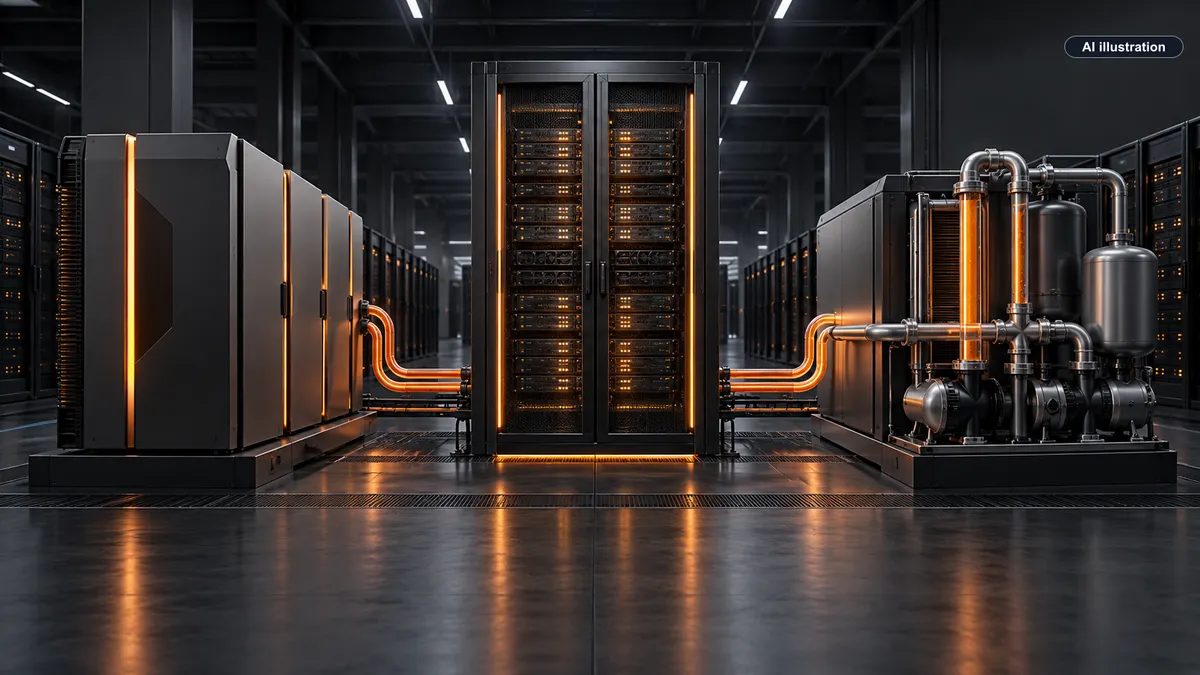
NVIDIA is extending its AI-factory pitch beyond GPUs and networking. On September 21, the company introduced DSX Ready, a qualification program for partner products that meet selected requirements in its DSX reference designs. The first categories cover battery energy storage systems and cooling distribution units.
The launch matters because power and cooling are now procurement constraints, not background facilities work. A fast accelerator does not create useful capacity if a site cannot absorb load changes, reject heat or integrate equipment safely. DSX Ready gives buyers a vendor-defined shortlist, but it does not turn a component badge into proof that a complete data center will work.
What NVIDIA has qualified
NVIDIA names Hitachi Energy, LG Energy Solution and Tesla for battery energy storage systems. LG Electronics, LiquidStack and Vertiv are listed for cooling distribution units. More categories are planned across infrastructure and software.
The two initial paths are different. Battery partners run required tests and submit supporting data for NVIDIA review within a defined boundary. Cooling suppliers use a self-qualification suite to determine whether a specific product meets applicable functional requirements. That distinction belongs in a buyer's record: review by NVIDIA and supplier-run self-qualification do not provide identical evidence.
NVIDIA also states an important limit. Passing the program does not replace site-level engineering and does not imply site-level stability. A qualified cooling unit may satisfy the relevant component criteria while the operator still has to determine whether it fits the site's water temperatures, redundancy plan, controls and maintenance model.
The system boundary is the real story
The accompanying DSX facilities documentation treats compute, power, cooling, controls and connectivity as one design problem. Its example site is explicitly a sizing reference rather than a promise for every deployment. That is useful context for the new program: qualification is intended to make individual building blocks easier to evaluate inside a larger architecture.
NextWith's assessment is that the program signals a shift in where AI infrastructure vendors compete. Accelerator specifications remain important, but operators increasingly need repeatable answers about grid connection, load variation, thermal design, commissioning and fault recovery. A qualification catalog can reduce the search space. The commercial value depends on whether it also exposes enough test detail for engineers to understand what was actually proven.
Four questions for infrastructure buyers
First, identify the exact product and version. A supplier name is too broad because firmware, controls, capacity and interfaces can change between models. The procurement record should connect the qualification to a specific configuration.
Second, ask for the boundary of the test. A component can pass a functional requirement while the complete chain still fails under a grid event, maintenance condition or control-system delay. Buyers need to know which interfaces and failure modes were included.
Third, compare the reference assumptions with the real site. NVIDIA's documentation describes BESS as deployment-specific and shows cooling arrangements built around defined temperatures, flows and redundancy. An operator should map those assumptions to local grid rules, climate, water strategy and planned rack density.
Fourth, require an integration owner and acceptance test. Qualification can support product selection, but someone still has to own commissioning across electrical, mechanical and software teams. The acceptance test should record normal operation, loss of a component, recovery time and the effect on available compute.
A useful badge needs an evidence trail
There is a straightforward way for DSX Ready to become more than a marketing label. Each listing can identify the qualified model, requirement version, test method, test operator, limitations and renewal date. Buyers could then distinguish current evidence from a legacy result and compare products without assuming that every badge covers the same conditions.
The program is new, so its practical effect is not yet established. NVIDIA has announced categories, participants and qualification paths, but it has not demonstrated in this announcement that DSX Ready reduces deployment time, prevents incidents or lowers total cost. Those outcomes need dated project evidence.
For AI teams, the immediate lesson is narrower. Infrastructure performance is a chain, and the weakest untested interface can set the real capacity. A qualified component is useful evidence inside that chain, provided its scope remains attached.
Before treating a DSX Ready badge as a buying decision, ask for the exact qualified model, test boundary, site assumptions and a dated integration plan for your own power and cooling design.


