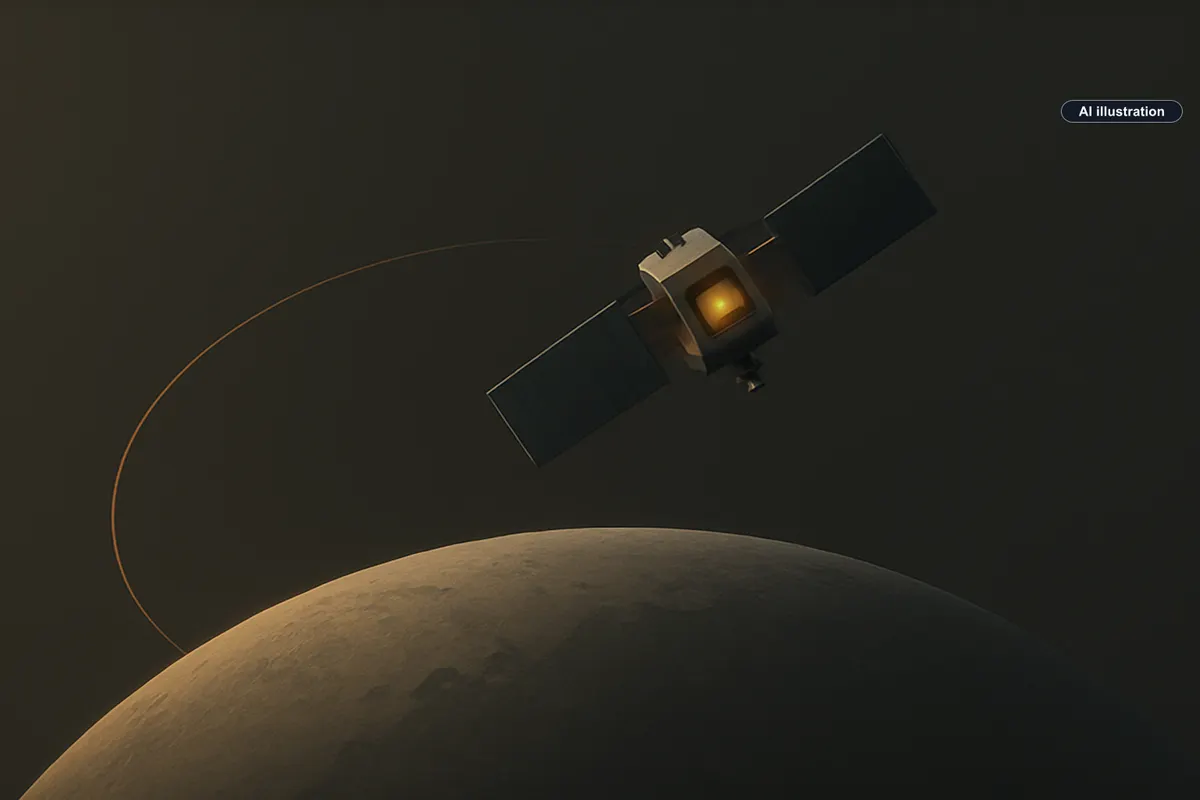
Google says the first orbital test of Project Suncatcher is scheduled for next week: a prototype satellite carrying the company’s Tensor Processing Units into low Earth orbit to test whether AI hardware can survive launch and the space environment. In its Sep. 24 post, Google described the mission as the first practical step in a longer research program for compute in orbit. The Verge reported that the launch is set for Oct. 1 aboard a SpaceX Falcon 9 rideshare mission.
What is confirmed, and what is still only a plan
The confirmed part is narrow but important: Google says it is preparing to fly a prototype, not a finished orbital data center. The company’s own announcement says the mission is meant to learn how its chips behave under vibration, radiation and thermal stress. That makes the launch a hardware validation exercise, not a demonstration that AI compute in space is already practical at scale.
That distinction matters. A prototype can survive some of the conditions of spaceflight and still fail the much harder test of sustained operation. Google’s post is explicit that “some things can only be tested in space,” which is a way of saying the flight is designed to produce measurements, not a product launch.
Why the engineering challenge is bigger than launch day
Google says it has already tried to de-risk the mission on Earth. According to the company, the hardware was vibration-tested to mimic rocket launch loads and exposed to proton-beam radiation while running AI workloads. Google says the Trillium TPUs held up well in those tests and survived a total ionizing dose beyond what they would face in a five-year mission. That is encouraging, but it is still laboratory evidence. Space adds a combination of variables that are difficult to replicate together: launch shock, radiation outside the atmosphere, and cooling in a vacuum.
Cooling is the most revealing constraint in Google’s account. On Earth, high-density AI hardware can dump heat into air-cooled or liquid-cooled infrastructure. In orbit, there is no airflow, so heat must be moved through a different thermal design. Google says it is experimenting with heat pipes and radiators, and The Verge reported that Google’s Travis Beals said the chips can only run for about 15 minutes before needing to cool down. If that is the operating window in flight, the mission is less about raw performance than about whether the hardware can handle repeated thermal cycles without failing.
Why this matters to AI infrastructure teams
The practical audience here is not just space engineers. It is anyone deciding whether AI compute must keep expanding inside terrestrial data centers, or whether alternative locations could eventually matter. Google’s broader thesis is straightforward: low Earth orbit offers near-continuous sunlight, which in theory could help power compute workloads differently from Earth-bound facilities. The company also says future satellites could be linked in clusters and communicate with lasers, creating a distributed orbital system rather than a single isolated test article.
That is a meaningful architectural idea because power, cooling and network design are the bottlenecks that shape AI infrastructure today. If an orbital platform could solve those constraints, it could change where compute is placed, how it is powered and how much land-based infrastructure is needed. But that “if” is doing a lot of work. Google has not shown that orbital compute will be cheaper, simpler or more reliable than existing facilities. What it has shown is that a major chip and model company is willing to spend engineering effort on the question.
The boundary between moonshot and roadmap
Google is careful to frame Project Suncatcher as a research moonshot. The company says the first launch is about seeing what works, identifying failure points and applying the results to future missions, with a larger milestone planned for 2027. That framing is important because it keeps the current mission in the category of basic feasibility work rather than near-term commercialization.
For readers who make decisions about AI systems, the useful takeaway is not that space has suddenly become a data-center option. It is that one of the largest AI hardware companies is now treating orbital compute as an engineering problem worth measuring in hardware, not just discussing in concept. If the test produces usable data on thermal behavior, reset rates or radiation effects, it will shift the conversation from speculation to evidence. If it does not, the launch will still have established a hard boundary: AI in space remains a physics experiment before it is a business model.
After launch, watch for Google’s in-orbit telemetry on temperature, resets and bit-flips; those measurements will show whether Suncatcher is surviving space or merely reaching it.