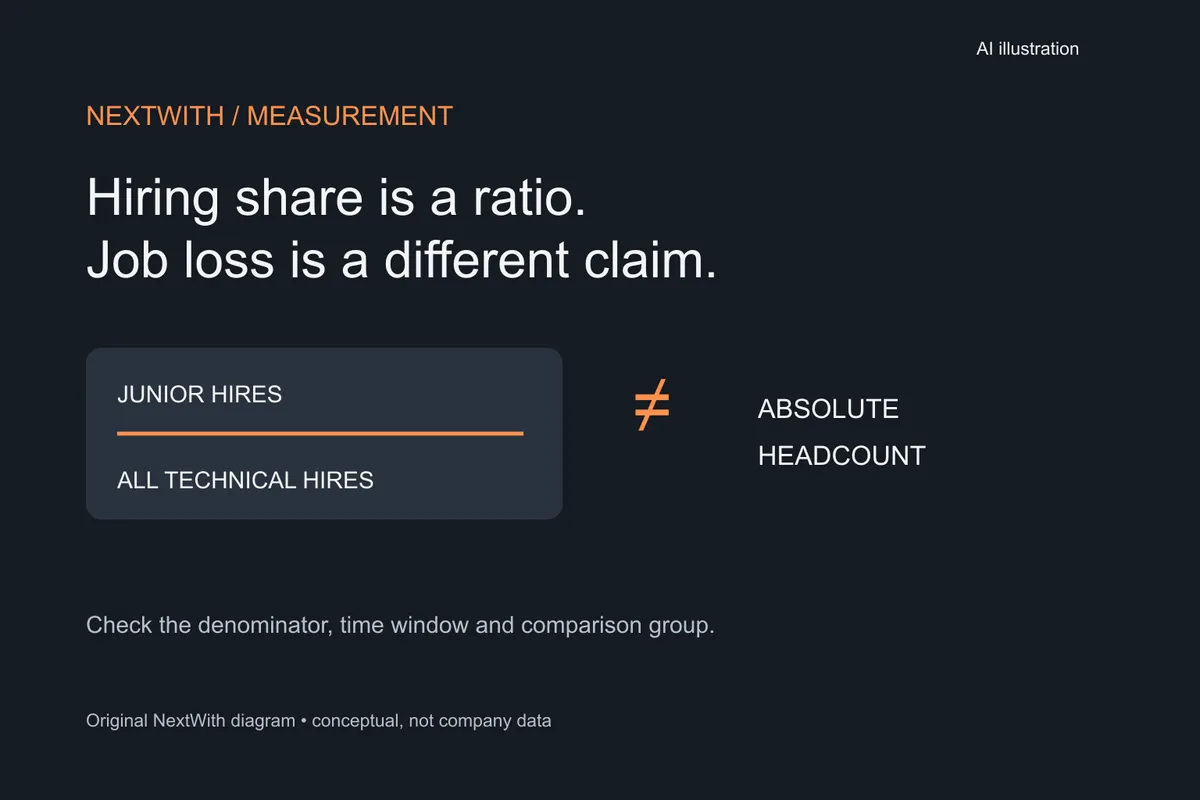
Anthropic’s October 16 employment study reports that junior workers’ share of technical hires fell from 27% to 9%. Absolute technical hiring still grew. The company also warns that adoption of agent tools was not random, limiting causal interpretation. These are internal company observations, not a representative labor-market experiment.
Our analysis starts with a distinction a headline can easily lose: the fraction of new recruits who are junior measures a hiring mix. It does not directly count existing employees, departures, layoffs or vacancies. Treating any one of those measures as interchangeable could lead a manager to change recruitment plans on evidence that answers a different question.
Keep the numerator and denominator in the same population
Consider a hypothetical employer, unrelated to Anthropic’s actual counts. It hires 100 technical employees in one period, including 27 juniors. In another equally long period it hires 400 technical employees, including 36 juniors. The junior share falls from 27% to 9%, yet the number of junior recruits rises. The arithmetic establishes a possibility, not what happened at Anthropic: percentages alone cannot recover the missing totals.
Notice what does not enter that calculation: sales hires, finance hires or the total company workforce. Those would change a different ratio. To evaluate junior technical hiring, the denominator must remain all technical hires in the relevant period. To evaluate the share of existing technical employees who are junior, both parts of the ratio must instead refer to the employee population at a specified date.
The next distinction is between a flow and a stock. Hiring is a flow over a time window; headcount is a stock at a point in time. Promotions can move people out of the junior category without creating a vacancy. Departures can change headcount without appearing as negative hires. A useful workforce table therefore keeps recruits, departures, promotions and ending headcount in separate columns, with consistent role definitions.
A comparison group helps, but does not remove selection
For a team evaluating an AI rollout, comparing adopters with non-adopters can be more informative than comparing the whole company before and after launch. It still needs a reason to believe the groups were comparable. Imagine two engineers with similar recent output. One joins a project with a looming deadline and starts using an agent. The other stays on routine maintenance. A later output gap could reflect the deadline, the project, the tool or several factors together.
This hypothetical example explains why matching on job title is insufficient. A stronger internal assessment would record prior output trends, project changes and the timing of adoption. A staged rollout could provide a clearer comparison if access timing were assigned independently of expected performance. That is a proposed evaluation design, not a claim about how this company allocated access.
Even a credible output effect would answer only the outcome actually measured. More completed tickets might coexist with more rework. More code might coexist with unchanged customer value. Before collecting numbers, choose an accepted deliverable and track the time spent reviewing or correcting it. Keep monetary cost and quality outcomes separate so a gain in one dimension does not silently stand in for a gain in every dimension.
What a defensible workforce conclusion would require
A manager considering changes to junior recruitment should ask for both absolute hiring counts and comparable shares over defined windows. If the decision concerns layoffs, examine departures and their documented reasons instead. If it concerns training, examine progression and supervision capacity. These are different decisions with different evidence requirements; none follows automatically from a single falling percentage.
The report provides a concrete reason to ask those questions, while the numerical example and evaluation framework above are our analysis. They do not establish which mechanism explains the observed shift, nor forecast employment elsewhere. The practical benefit is a narrower, testable decision: identify which workforce measure matters, then collect evidence that actually measures it.
Before changing a hiring plan, put absolute technical hires, junior hires, promotions and departures beside the percentage, then check whether your AI comparison groups were comparable.