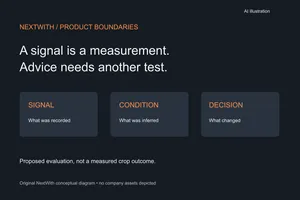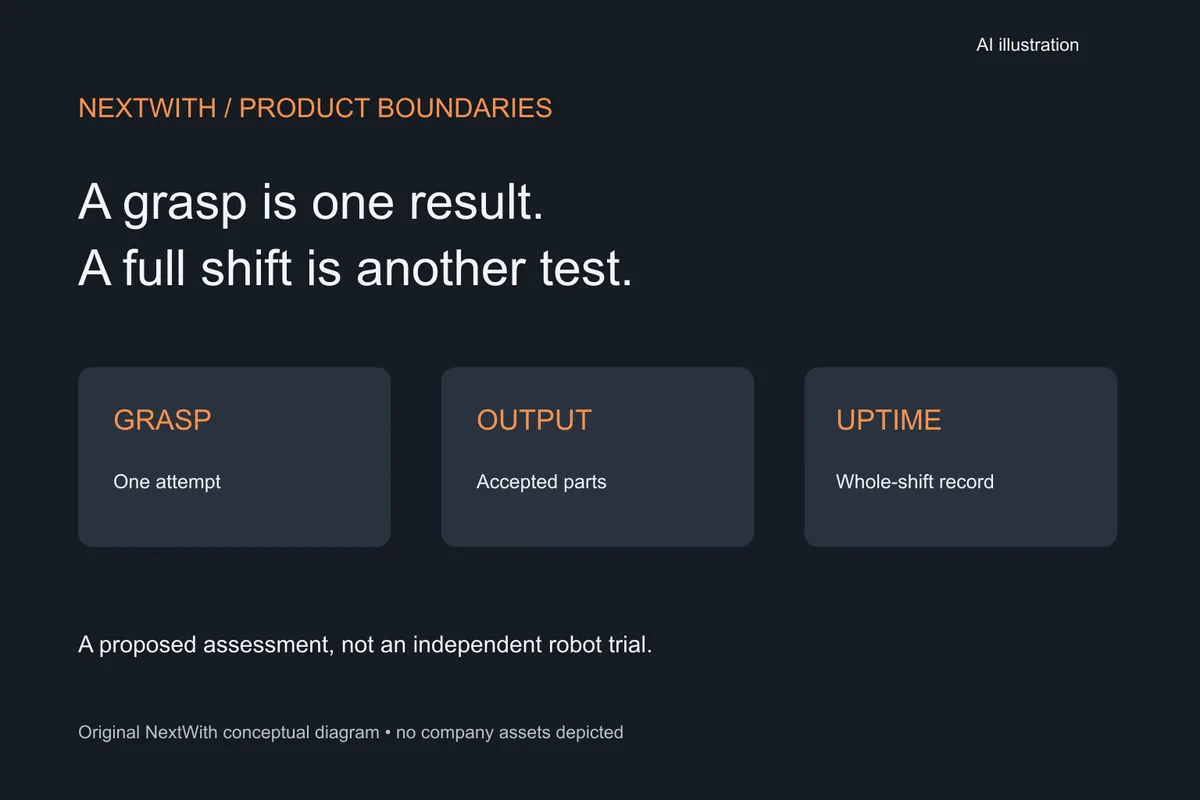
Eka Robotics describes its approach as a Vision-Force-Action model, intended to combine generality, performance and safety. Its company website puts force at the center of its physical-intelligence pitch. These are company claims, not independent findings about factory operation.
TechCrunch’s October 20 reporting describes a force-sensitive gripper, simulation-based reinforcement learning and industrial pilots in pick-and-place and wire manipulation. The distinction between those tasks is important: placing a rigid part and handling a flexible wire would require different acceptance conditions. NextWith has not tested the system. Our analysis asks what evidence would connect this particular force-first approach to an accepted result over a full factory shift.
What would a buyer need to measure?
Our proposed evaluation starts with a distinction between a grasp, a completed production task and an uninterrupted shift. These are different units. Picking up an object can be successful while its placement, inspection or handoff remains unfinished. A purchasing decision would need a definition of the accepted output before a headline rate becomes comparable with an existing process.
Consider a hypothetical station that moves parts from a mixed tray into an assembly fixture. Its useful output is an accepted part in the correct position, not simply an object lifted from the tray. Write the acceptance condition first: placement within the required tolerance, no visible damage and a recorded handoff to the next step. Those are illustrative requirements, not specifications supplied by Eka or results from a test we conducted.
A trial could then record every attempted cycle, including retries, rejected parts and occasions when a person intervenes. If the published rate counts one kind of event while the buyer counts another, the comparison would answer the wrong question. Retain both measures rather than relabeling attempts as finished units.
The denominator matters as much as the demonstration
A proposed trial should describe the object mix, including which objects are absent. Repeat runs with the same easy arrangement would offer different evidence from runs with varied positions and difficult items. Record the arrangement, lighting and tool configuration with each result so that an improvement cannot silently be credited to the model when the surrounding setup changed.
Failures also need distinct categories. A dropped object, an undetected damaged part and a harmless refusal to continue would have different implications for this hypothetical station. A single success percentage would conceal that difference. In particular, an appropriately stopped process could reduce output while preserving a necessary boundary; it should not be described in the same way as an accepted but defective result.
None of this establishes that Eka has a particular failure mode. It defines the records needed to investigate performance in a specified workflow. The point of the trial would be to discover the distribution of outcomes, including inconvenient ones, rather than reproduce a selected demonstration.
Reliability includes getting back to work
In our hypothetical purchasing assessment, a full-shift record would include setup, calibration, replenishment and recovery time. A station that works quickly between interruptions could still deliver fewer accepted units than expected over the whole shift. Record the interruption’s cause and the actions needed to resume, rather than reporting only the best continuous interval.
Separate model recovery from maintenance of the physical system. A successful retry after an uncertain grasp is one result; a person replacing a worn component is another. The buyer would need to know who performed each action and how long the station remained unavailable. These are proposed evaluation questions, not a claim about the service life of Eka’s equipment.
Make the commercial comparison specific
The relevant comparison for that station would be accepted units over the agreed operating period, with the same object mix and quality conditions. Include the labor needed for supervision and recovery. If a different setup removes a difficult step from the robot’s task, document the extra work elsewhere in the process instead of treating it as a free gain.
The reported pilots supply specific workflows to examine. A useful deployment decision would require a different evidence package: a defined task, comparable results, a failure record and a plan for maintenance and recovery. Keeping those questions separate leaves room to recognize a technical advance while preserving the distinction between an impressive grasping demonstration and an industrial service commitment.
Before comparing a robot’s headline speed with an existing station, define accepted output and require a full-shift record that includes retries, intervention and recovery.