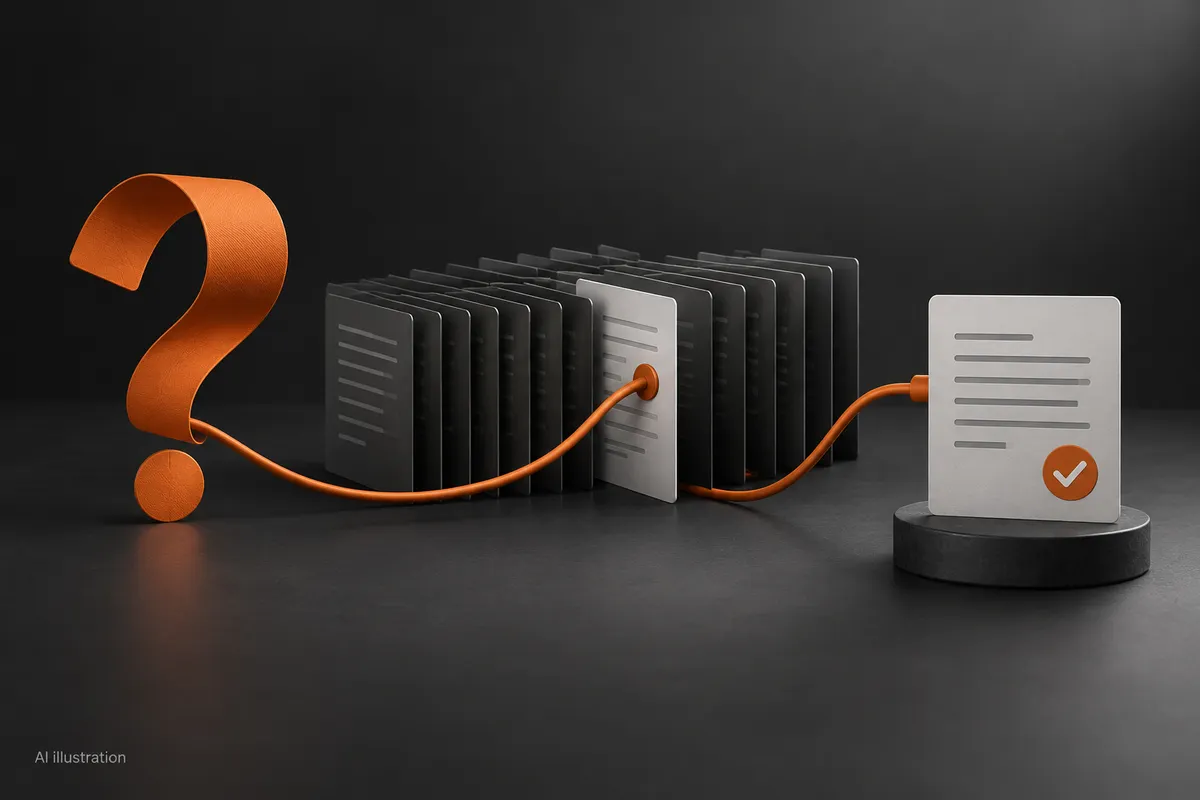

Image: NextWith.ai — AI-generated conceptual illustration.
A model can win an impressive benchmark and still be the wrong choice for your work. The missing piece is usually the task: what you need it to produce, what counts as an error and how much checking you can afford.
For a small team choosing an AI tool, a short, repeatable comparison is more useful than an afternoon of increasingly elaborate prompts. This is a proposed evaluation workflow, not a report of testing by NextWith.ai.
Write the acceptance rule first
Before opening a chatbot, describe one recurring job. “Help with documents” is too broad. “Extract the renewal date from a contract and point to the sentence that supports it” is testable.
Anthropic's evaluation guidance recommends defining specific, measurable criteria and evaluating against the application's actual needs. It treats quality, consistency, latency and cost as separate dimensions. That is a useful discipline even when you are comparing other vendors.
Our suggested starting point is a small set of non-sensitive examples you understand well. Include a straightforward case, a messy one, an ambiguous case and one where the requested answer is absent. The last example matters: a confident invention should not beat an honest explanation of missing information.
Keep the comparison fair
Give each candidate the same material and the same requested output. Record the model version, date, enabled tools and relevant settings. If one tool browses the web while another only sees the pasted document, you are comparing different workflows; label that difference.
Do an initial pass without tweaking each prompt to rescue a weak answer. Then, if you want to optimise each tool separately, record that as a second round. Otherwise, time spent coaching a favourite model can disappear from the comparison.
- Correctness: Is the answer supported by the supplied material?
- Completeness: Did it include every requested field?
- Uncertainty: Did it identify an absent or ambiguous answer?
- Effort: How much editing and verification remained?
Choose the workflow you can sustain
A quick answer that takes ten minutes to check may be less useful than a slower answer with clear evidence. Keep those observations alongside the bill rather than compressing everything into a single score.
A small trial can eliminate obvious mismatches; it cannot establish reliability across every future document. Keep a separate set of examples for a final check, and add real failures to later evaluations. Revisit the choice when the model, task or connected tools change.
The practical result should be a narrow conclusion: this setup is suitable for this job under these conditions. That is a stronger reason to adopt a model than its position on a general leaderboard.
Documentation reviewed September 13, 2026.