
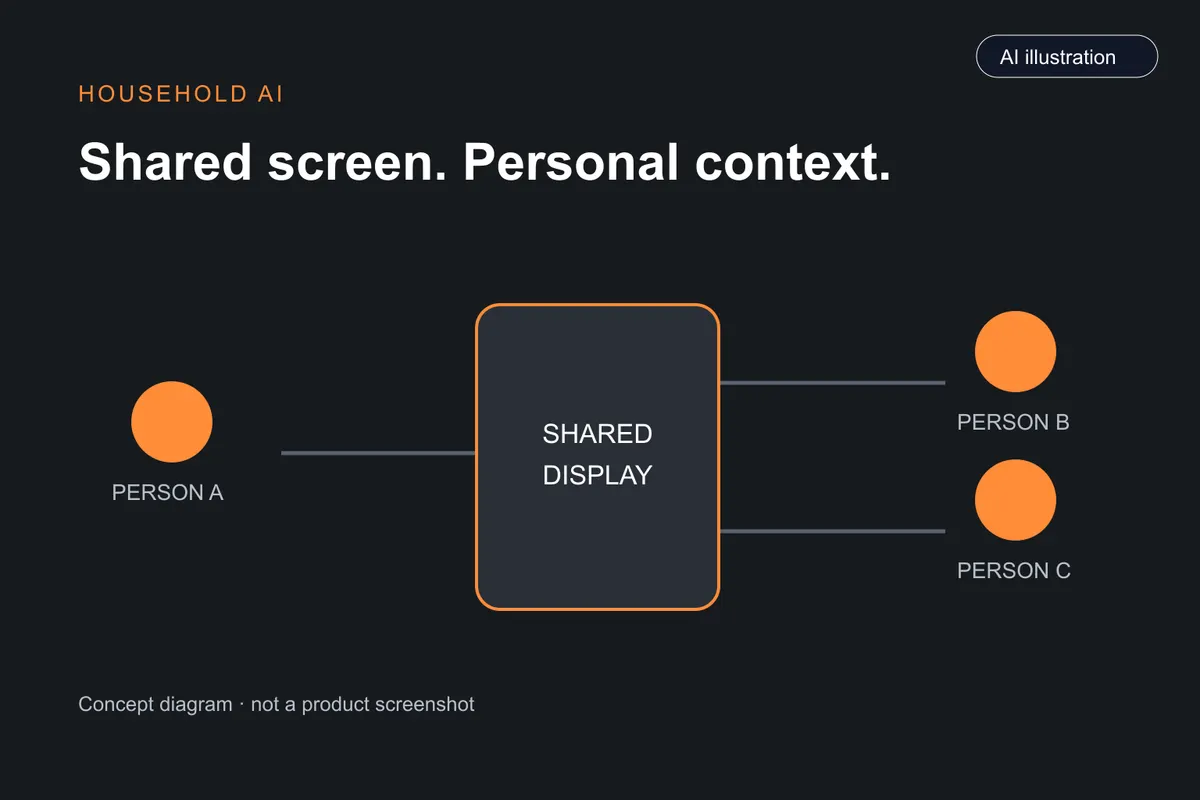
Apple introduced HomeView on October 13, placing Siri AI on a screen intended for several people in the same home. Its announcement describes face recognition for up to six users and individual home screens. Personal-context features depend on an Apple Intelligence-enabled iPhone or iPad. Apple separately says general knowledge, conversation and music discovery can benefit people without that paired device.
CNBC’s launch coverage reports the seven-inch device starting at $299. Apple says preorders begin on October 13 and availability starts November 13. The announcement is evidence of the product’s intended features and schedule; it is not our own test of how reliably identification or personal-context handling works.
A shared display changes the evaluation question
The particular issue raised by this announcement is the connection between a communal screen and information tied to an individual. Apple says HomeView can surface personal content from apps including Messages and Calendar, and says that personal content stays private from others. Those are company claims. A person considering the device should evaluate the shared-screen experience as well as the assistant’s answer quality.
Consider a household using one screen for music and for an individual’s calendar. Correctly answering a calendar request would be one useful result. Showing that answer in the intended person’s context would be another. The announcement does not give us independent evidence about what happens when someone else walks into view, when people stand together, or when an interaction moves from a shared task to a personal one.
That is not a report of a flaw. It is a set of questions created by the product’s own shared-and-personal proposition. A demonstration with one identified user could show an appealing interaction while leaving multi-person behavior unexamined. A review that follows the transition between users would answer a more specific question than a review that only lists the available apps.
Pairing and identification are different checks
For a buyer, the paired-device requirement creates a second decision alongside the screen itself. A household member may want only general conversation or music discovery, while another may want answers that depend on personal information. Apple’s description supports treating those as different use cases. Owning the display alone should not be read as evidence that every person can use every personal-context feature.
A useful comparison can begin with the task rather than with the product label. Write down the intended request, identify the person whose information is relevant, and check whether that person has a supported device. Then distinguish an answer based on general knowledge from an answer based on private app context. That approach makes the compatibility question concrete without assuming that the two forms of assistance have identical requirements.
If independent reviewers test the device, an informative result would name the accounts, paired devices and task types involved. A successful request made with one configured device does not establish behavior for another household member with a different setup. Conversely, a missing feature in an unsupported setup would not by itself establish that a supported configuration is defective.
Check the market before planning the setup
The Guardian’s Reuters report attributes to Apple the statement that HomeView will not be sold in the European Union because Siri AI remains unavailable there under EU regulations. That is the company’s reported availability explanation, not a legal finding by this publication. The U.S. price and launch schedule should not be substituted for an EU purchasing promise.
Local availability can settle whether a proposed purchase is possible before any discussion of household fit. For someone outside the announced sales markets, a product announcement and an international press page are not sufficient evidence of a local release. For someone in a supported market, the next question is whether the intended personal-context tasks are supported by the household’s devices.
The immediate value of the announcement is therefore a defined product proposition that can be examined: individual context on a screen shared by several people. Apple’s claims explain the intended experience. Compatibility information and independent reviews will be needed to assess particular setups. We have not tested profile switching, observed private information being exposed, or verified the company’s privacy assurances in actual household use.
Before buying HomeView for personal-context tasks, verify supported devices and local availability, then look for independent tests of profile switching in a shared room.


